91制片厂

Building Community Through Creativity

The DI Creatives-in-Residence Program's Impact in Northeast Ohio

Over the past year, five Northeast Ohio artists, designers, and creative practitioners transformed the Design Innovation Hub into a laboratory for creative experimentation, public engagement, and interdisciplinary exploration.

Through exhibitions, workshops, public showcases, immersive installations, fashion collections, and community conversations, the Design Innovation (DI) Creatives-in-Residence Program connected 1,744 community members with new ideas at the intersection of art, design, culture, and technology. The residency supported projects exploring everything from artificial intelligence and future food systems to cultural memory, digital craftsmanship, immersive environments, and sustainability. Throughout the year, DI Creatives-in-Residence exhibited their work through public exhibitions, workshops, demonstrations, community events, the 91制片厂 Fashion Show, Akron Soul Train, Design Innovation Day, and dedicated residency showcases that invited community members to engage directly with the creative process.

The DI Creatives-in-Residence Program was made possible by a generous gift from long-time supporter of Design Innovation, Ken Robinson, and an investment of public funds from the Ohio Arts Council (OAC). The OAC is a state agency that funds and supports quality arts experiences to strengthen Ohio communities culturally, educationally, and economically.

Food Futures: Imagining the Next 200 Years of Food

91制片厂 alumna and interdisciplinary artist Charisse Harris explored the future of food, technology, and culture through Food Futures: An Immersive & Visual Narrative. Combining projection mapping, speculative food design, scent, edible experiences, and AI-generated imagery, Harris transformed a traditional dining experience into an immersive installation that imagined how biotechnology, climate adaptation, and artificial intelligence might shape food systems and social rituals two centuries into the future.

Drawing on research in speculative design, digital storytelling, environmental futures, and AI-generated visual culture, Harris created an experience that invited visitors to consider both the promises and challenges of technologically mediated food systems. Throughout the residency, she experimented with AI image generation, projection mapping, sound design, and immersive installation techniques to create a hybrid exhibition that blended physical and digital experiences. As Harris noted:

I am very pleased that the project also highlighted the value of speculative artistic practice as a tool for imagining possible futures and prompting reflection on present-day systems. This was made possible through all the tools and technology available at the DI Hub.

The final installation sparked meaningful conversations among visitors about technology, culture, and the future of shared human experiences. As one attendee noted, "It was thought-provoking and very fun to watch!"

The Memory Mirror: Visualizing Human Emotion

Graduate student Sanmitha Nantur Ganesh explored the relationship between artificial intelligence, memory, and storytelling through The Memory Mirror, an interactive installation that transformed spoken memories into AI-generated visual artworks. Using voice recognition, emotion detection, prompt engineering, and image generation technologies, participants could share personal memories and watch them become unique visual interpretations in real time.

The project evolved from a simple AI image generator into what Ganesh described as an "emotion-driven memory visualization system," creating a complete user journey that encouraged reflection, storytelling, and personal connection. Visitors spoke memories aloud, watched AI transform them into visual narratives, and could save their creations through a QR-code-enabled sharing system. Reflecting on the experience, Ganesh shared that the residency transformed her perspective as a data scientist:

Previously, I viewed coding as a purely logical activity focused on efficiency and correctness. Through this project, I began to see coding as a form of digital storytelling, where algorithms can shape experiences and evoke emotions.

Tomographic Haunts: Reconstructing Memory Through Immersive Space

91制片厂 alumnus Connor Ruppelt used 3D scanning, digital assemblage, animation, and immersive media to create Tomographic Haunts, an evolving body of work exploring memory, place, and digital reconstruction. Throughout the residency, Ruppelt collected and manipulated hundreds of 3D scans of everyday environments, architectural spaces, objects, and landscapes, transforming them into fragmented digital worlds that visitors could explore and experience.

His work blurred the boundaries between documentation and imagination, combining real-world scans with digital collage techniques to create dreamlike environments that felt simultaneously familiar and unfamiliar. The project culminated in animated visual compositions, reconstructed architectural forms, and immersive virtual reality experiences that challenged audiences to think differently about how spaces are remembered, archived, and reimagined through technology. Looking back on the residency, Ruppelt noted that access to the Design Innovation Hub allowed him to process...

...images and ideas, both internally and externally. The work I was able to make felt very fresh and exciting within the context of my own art practice.

笔辞偶别驳苍补苍颈别: Memory, Heritage, and Migration

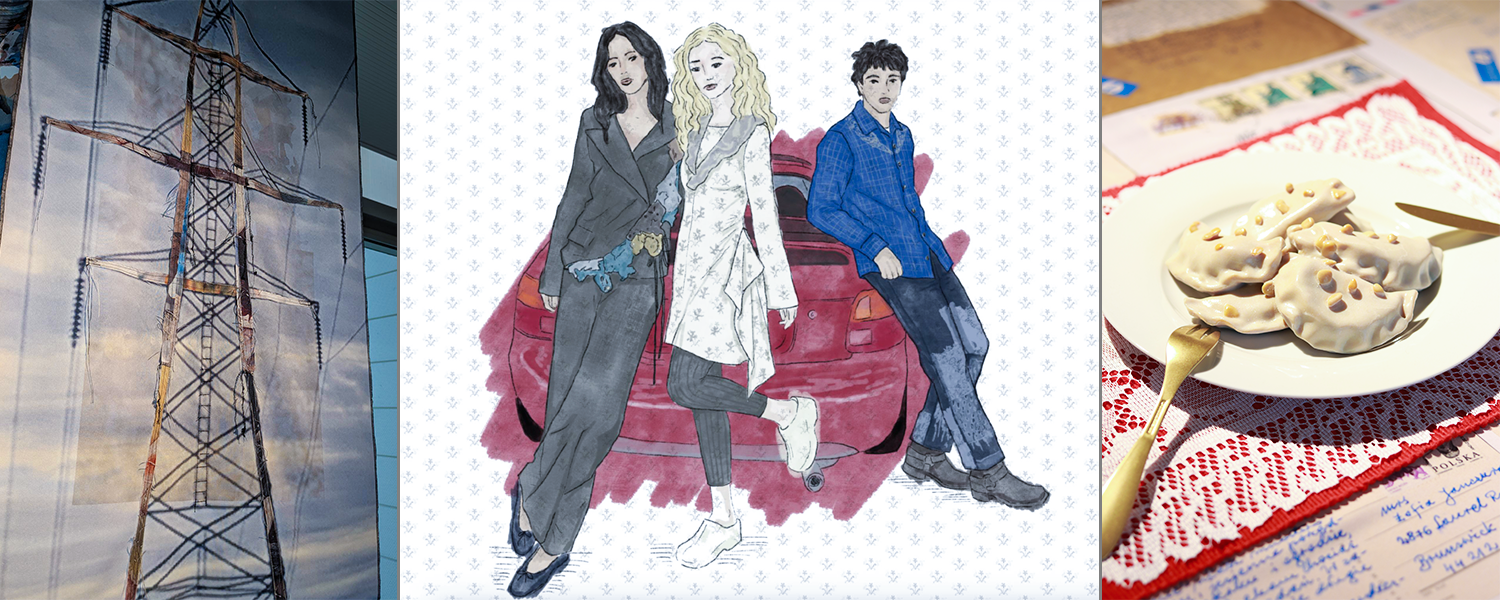
Community artist Kim Kapera explored themes of memory, identity, migration, and Polish heritage through 笔辞偶别驳苍补苍颈别 ("Farewell"), a deeply personal exhibition inspired by family photographs, heirlooms, letters, folk traditions, and stories passed between generations. Using photography, laser cutting, dye sublimation, digital fabrication, and mixed-media installation, Kapera transformed family artifacts into contemporary works of art.

Among the exhibition's featured works were reinterpretations of traditional Polish paj膮ki decorations, a contemporary folk vest inspired by the embroidered gorset, interactive textile installations based on immigration documents carried by her family aboard the MS Batory in 1968, and sculptural recreations of family traditions centered around food and memory. Visitors were invited to physically interact with portions of the exhibition, uncovering layers of imagery and history while engaging with themes of nostalgia, belonging, and cultural identity. Reflecting on the experience, Kapera shared that while developing new technical skills was valuable, the residency's greatest impact was giving her the confidence to create. She noted that being surrounded by other artists and makers working on ambitious projects made the experience both meaningful and inspiring:

The technical skills I was able to cultivate over this time have been impactful, but I think the most successful component of this time was that I finally felt empowered to create. Being surrounded by so many other people working on really interesting projects was motivating, and made this experience both meaningful and fun.

Of Petal & Pelt: Reimagining Craft Through Technology

Fashion Design student Mimi Lemar explored the relationship between historical craftsmanship and contemporary technology through Of Petal & Pelt, a collection of three garments created using laser cutting, raster engraving, dye sublimation, and repurposed materials. Inspired by lacework, ornamentation, and traditional textile practices, the collection asked a central question: can technology replicate craftsmanship, or does it create an entirely new form of craft?

The final collection featured three fully realized looks created from deadstock and repurposed materials that deconstructed and reimagined lace through digital processes. Along the way, Lemar discovered that working with technology often meant embracing unpredictability rather than pursuing perfection. Upon completing her residency, Lemar reflected:

My Creatives-in-Residence experience challenged me creatively and personally. It taught me to embrace experimentation, accept unpredictability, and view technology as a collaborator rather than simply a tool.

Lemar also shared her work with the public through two workshops titled Innovations in Sustainable Textile Design, introducing participants to sustainable textile practices, digital fabrication methods, and the creative possibilities of emerging technologies. These workshops provided hands-on opportunities for community members to learn, create, and experiment alongside the artist.

A Year of Community Impact

The work of the five DI Creatives-in-Residence extended far beyond individual projects. Throughout the year, residents participated in exhibitions, workshops, public receptions, artist talks, the 91制片厂 Fashion Show, Akron Soul Train exhibitions, Design Innovation Day, and other community-facing events that made art and technology more accessible to audiences across Northeast Ohio. In total, the program engaged 1,744 community members through free public programs and exhibitions. Visitors interacted with immersive installations, participated in workshops, explored sustainable design practices, contributed personal memories to AI-powered experiences, and engaged with new perspectives on culture, identity, technology, and creativity.

One attendee summarized the spirit of the final showcase simply: "I enjoy the creativity on display by such talented students!"


Continuing Your Creative Journey

While the DI Creatives-in-Residence Program has concluded, the tools, technologies, and creative community that supported these projects remain available through Design Innovation. Whether you're an artist exploring a new medium, a designer developing a portfolio, a maker building a prototype, or a community member with a creative idea you'd like to bring to life, Design Innovation offers membership opportunities that provide access to makerspaces, studios, emerging technologies, workshops, and a vibrant community of creators.

Many of the projects showcased through the CIR Program began as simple questions, experiments, and ideas. With access to the right tools, mentorship, and creative community, those ideas grew into exhibitions, workshops, installations, and experiences that impacted hundreds of people throughout Northeast Ohio.

To learn more about DI membership and how to start your own creative journey, visit the Design Innovation website.


Get Started with DI

POSTED: Wednesday, July 1, 2026 12:16 PM
Updated: Wednesday, June 24, 2026 01:25 PM
WRITTEN BY:
Chris Holthe